
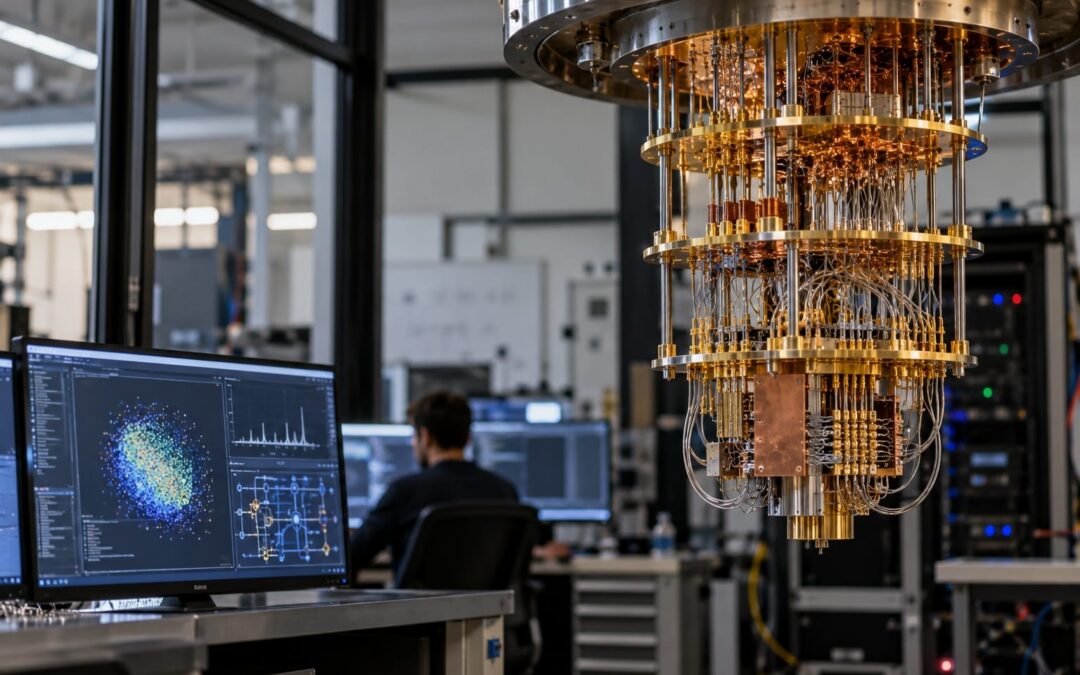
Quantum computing has spent many years occupying an unusual position in technology.
It is potentially revolutionary, enormously complicated and perpetually described as being just around the corner.
Researchers believe quantum computers could eventually solve certain problems that even the world’s most powerful conventional computers cannot handle efficiently.
Potential applications range from discovering new materials to simulating molecules, improving optimization and understanding complex physical systems.
But there has always been an important question.
When does quantum computing become genuinely useful?
Recent research may be bringing us closer to an answer.
In July 2026, IBM and researchers from the University of Chicago announced an experiment they say demonstrated quantum advantage while also addressing one of the field’s most difficult problems: how to trust the answer produced by a quantum computer when the calculation is too difficult for a conventional computer to verify.
That makes this a good time to ask what quantum advantage actually means.
Quantum Computers Work Differently
Traditional computers process information using bits.
A bit is either a zero or a one.
Quantum computers use quantum bits, or qubits.
Because of properties of quantum mechanics, qubits can represent information in ways conventional bits cannot. Quantum systems can also create relationships between qubits that allow certain calculations to be structured very differently.
That does not mean a quantum computer is simply a faster computer.
For most everyday tasks, a conventional computer remains the better machine.
You probably do not need a quantum computer to browse the internet, create a spreadsheet or run an accounting system.
The potential appears when dealing with certain types of problems whose complexity grows extremely quickly.
Simulating quantum chemistry is one example.
Nature itself operates according to quantum mechanics. Trying to simulate a complicated molecule on a conventional computer can therefore become extraordinarily difficult as the number of interacting particles increases.
A quantum computer may be better suited to the problem because it is itself a quantum system.
What Is Quantum Advantage?
The term “quantum advantage” is sometimes confused with another phrase, “quantum supremacy.”
Both broadly refer to situations where a quantum computer can perform a computation beyond the practical capability of classical computers.
But there is an important distinction in how the technology is now being discussed.
Researchers increasingly want quantum advantage to mean more than completing an artificial benchmark created specifically to make a quantum computer look impressive.
The goal is to perform useful computations that classical computers cannot realistically reproduce.
IBM’s current roadmap describes quantum advantage as workloads in which quantum computation provides a meaningful advantage when integrated with high-performance classical computing.
That last part matters.
The future may not involve quantum computers replacing classical computers.
It may involve the two working together.
The Problem of Trust
Quantum advantage creates a strange problem.
Suppose a quantum computer performs a calculation that would require an impractical amount of time for the world’s best classical computer.
How do we know the quantum computer got the answer right?
Normally we verify a calculation by checking it with another method.
But if the calculation is too difficult for classical computers, direct verification may not be possible.
That is one of the most interesting aspects of IBM and the University of Chicago’s recent work.
Researchers used a technique designed to demonstrate that the quantum computation was operating correctly even when classical computers could no longer reproduce the complete result.
The experiment encoded 70 logical qubits and completed its quantum calculation in approximately 15 minutes. IBM said reproducing the task using leading classical simulation methods would require an infeasible amount of computing time.
Just as importantly, the system included methods for validating the computation.
IBM described this as “trusted quantum computation.”
The distinction is important because an answer that cannot be trusted is not particularly useful, regardless of how difficult the calculation was.
Errors Remain the Central Challenge
Quantum computers are extremely sensitive machines.
Qubits can be affected by noise, temperature, electromagnetic interference and imperfections in the hardware.
As computations become longer and more complicated, small errors can accumulate.
That is why quantum error correction has become one of the central goals of the industry.
Instead of relying directly on individual physical qubits, researchers can combine multiple qubits to create what is known as a logical qubit.
The purpose is to detect and correct errors while preserving the information needed for the computation.
This comes at a cost.
Creating reliable logical qubits can require many physical qubits.
But progress in error correction is important because useful quantum computers will eventually need to perform complicated calculations without errors overwhelming the result.
IBM’s July demonstration is notable partly because it combined logical quantum circuits with verification methods in a computation that researchers argue reached beyond practical classical simulation.
Why Does Any of This Matter?
Quantum computing will become truly interesting when it begins solving problems scientists and businesses actually care about.
Chemistry is one of the most frequently discussed possibilities.
Designing a new battery material, catalyst or pharmaceutical can involve understanding interactions between atoms and electrons.
Those interactions are quantum mechanical.
Conventional computers use approximations because exact simulations can become impossibly complicated.
Quantum computers could eventually allow researchers to model certain systems more accurately.
Materials science offers similar possibilities.
In another 2026 result, IBM and Algorithmiq reported progress using quantum computers to simulate heterogeneous quantum materials while developing methods to validate results beyond straightforward classical verification.
That does not mean quantum computers are about to redesign every battery or discover new drugs next year.
It means researchers are beginning to explore problems closer to the areas where quantum computing could eventually provide practical value.
Quantum Will Probably Work With Classical Computing
One common misconception is that quantum computers will eventually replace conventional computers.
That is unlikely.
Quantum computing is highly specialized.
Classical computers are extremely good at the vast majority of computing tasks.
A more likely future is hybrid computing.
A conventional supercomputer might manage a large problem, prepare data and perform most calculations. A quantum processor could handle the specific portion of the problem where quantum techniques offer an advantage. The result would then return to the classical system.
IBM explicitly describes its quantum roadmap in this way, integrating quantum processors with high-performance computing rather than treating them as replacements.
This resembles other developments in computing.
Graphics processing units did not replace conventional processors. They became specialized components that are exceptionally good at particular workloads.
Quantum processors may eventually play a similar role.
A Milestone, Not the Finish Line
Quantum computing still faces enormous technical challenges.
Machines need to become more reliable.
Error correction must improve.
Useful algorithms need to be developed.
Hardware must scale.
Researchers also need to continue testing quantum advantage claims against improving classical algorithms.
That final point matters because classical computing does not stand still.
When researchers announce that a quantum system has performed a difficult calculation, classical computing experts often discover better ways to simulate part of the experiment.
The competition itself helps both fields improve.
Quantum advantage therefore should not be viewed as a single finish line that the industry crosses once.
It will probably emerge gradually across different types of problems.
The important development is that researchers are moving beyond simply asking whether quantum computers can perform unusual calculations.
They are beginning to ask whether those calculations can be useful, trusted and integrated with the computing systems we already have.
That is a much more meaningful test.
And if quantum computers continue passing it, the technology may finally begin moving from promise toward practical computing.
