
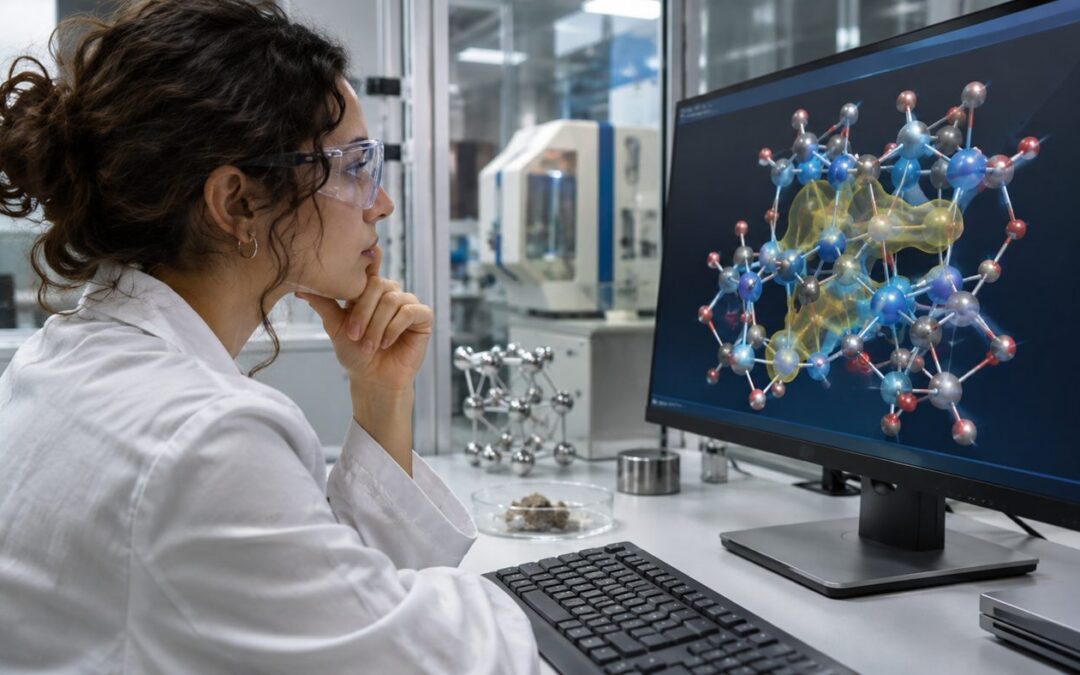
New materials can change what technology is able to do.
A better battery material could store energy differently. A new semiconductor could help engineers build different electronic devices. A more effective catalyst could alter the way a chemical reaction takes place.
Finding those materials is difficult. Researchers must understand how atoms and electrons interact, predict which combinations may be useful and then test their ideas in the laboratory.
Quantum computing may eventually provide another tool for that process. Its promise is not that it will replace experiments, but that it could help scientists study some systems that are especially difficult to model.
Why Materials Are Hard to Predict
The properties of a material depend on more than the elements it contains. The arrangement of its atoms and the behavior of its electrons also matter.
As a system becomes more complicated, calculating those interactions accurately can require enormous resources. Conventional computers already use a range of powerful methods and approximations to study molecules and materials. Those methods are indispensable, but they involve choices about which details to include and which to simplify.
The challenge is to make a calculation accurate enough to guide a useful decision while keeping it practical to perform.
A Different Way to Model Nature
Quantum computers use quantum bits, or qubits, to process information. Because molecules and materials themselves follow quantum rules, researchers are investigating whether a quantum system can help simulate aspects of another quantum system.
In principle, a sufficiently capable quantum computer could help estimate properties such as the energy of a molecular configuration. Such calculations might help researchers compare possible reactions or understand why a material behaves as it does.
That does not mean every materials problem will become easy. A useful calculation still requires a suitable algorithm, an accurate representation of the system and a way to interpret the result.
From Calculation to Candidate
Imagine researchers looking for a material that can support a particular chemical reaction. They might use calculations to identify promising candidates, then make and measure those candidates in a laboratory.
A better calculation could help narrow the search or explain an unexpected result. But the best result on a computer screen is not automatically the best material for a real application.
Researchers must also consider stability, cost, safety, availability and whether the material can be manufactured consistently. A candidate that performs well under controlled conditions may behave differently in a working device.
Discovery is therefore a cycle of prediction, experiment and revision.
The Limits of Today’s Machines
Current quantum computers are limited by noise and errors. Qubits are delicate, operations are imperfect, and longer calculations provide more opportunities for errors to accumulate.
Researchers are exploring error correction and other techniques to improve reliability. Building a machine that can carry out demanding chemistry calculations accurately at useful scale remains a substantial challenge.
Classical computing is also advancing. Any future quantum method will need to demonstrate that it adds value compared with the best practical alternatives, including the cost and time required to use it.
One Tool in a Larger Process
Quantum computing is unlikely to produce a new battery or semiconductor by itself. Its potential lies in helping researchers answer questions that are difficult to resolve with existing tools.
Conventional simulation, data analysis, laboratory measurements and engineering will remain essential. If quantum computers become reliable enough to contribute, they will work alongside those methods.
The opportunity is significant, but so is the work ahead. The real measure of progress will be whether better calculations lead to materials that can be made, tested and used in the world.
